This is not an argument against four-year programs. They are rigorous, valuable, and, for many students — particularly those seeking graduate-level specialization, research careers, or a foundational college experience — exactly the right fit. This is an argument for expanding the conversation: for making room in the industry’s collective thinking for a different but equally rigorous path, one that community college certificate programs have been steadily building for years.
Different programs fulfill different needs. Recognizing that fact — genuinely, not just rhetorically — is how the interior design profession builds a healthier, more sustainable talent pipeline.

West Valley College’s 60-unit Interior Design Professional Certificate is, by design, a focused program. Every unit is tied directly to the discipline. Students move through technical skills, design theory, and studio coursework without the detours that a broader general education curriculum requires. This is not a comment on the value of general education — it clearly has significant value — but rather an acknowledgment that different program structures serve different student needs and life circumstances.
For a 35-year-old with a business degree who has decided to transition into interior design, spending two years on biology, history, and composition requirements may not be the right path. For an 18-year-old exploring their academic identity for the first time, a broad university education may be exactly what they need. Both students are making the right choice for their circumstances. The profession benefits when both pathways are valued.
Importantly, the WVC certificate is structured to meet the educational requirements for the NCIDQ examination — the same professional licensure benchmark that four-year graduates pursue. The goal is not a lower bar; it is a differently shaped path to the same standard.

Community college interior design programs like WVC operate on a fundamentally different instructional model from traditional universities. Rather than relying primarily on full-time tenured faculty, courses are taught by active industry professionals — designers, project managers, and business owners who work in the field during the day and teach part-time on the side. Many of them also serve as adjunct faculty at four-year institutions, meaning the pedagogical rigor is not absent — it is paired with current, real-world practice.
This is a different kind of strength, not a superior one. University faculty bring more in-depth research, long-term mentorship relationships, and theoretical frameworks that shape students’ conceptual thinking about design. Practitioner-instructors have a higher focus on real-time market relevance — the software firms are actually using, the client management challenges that surfaced last quarter, the code compliance issue that came up on a project last month. Both have educational merit. Both produce different kinds of learning.
WVC also maintains an active industry advisory board comprising local design professionals and firm leaders. This body reviews the curriculum annually, ensuring that what students learn reflects what the market actually needs — not just technical skills but also soft skills, professional workflows, and emerging technologies such as generative AI tools. Responsive curriculum development of this kind is an asset the profession should recognize and support.

It is worth being specific about the student population these programs serve, because the assumptions that sometimes surround community college education do not match the reality.
WVC’s certificate program attracts a wide range of students: recent high school graduates who are clear about their direction and want to move purposefully into the field, mid-career professionals pivoting from business, psychology, marketing, or project management, internationally trained designers seeking U.S. credential recognition, and individuals who have always wanted to work in design but needed a program that fits around a job and a family. These are motivated, purposeful students who have made a conscious decision to invest in this field. For some, the certificate is also a deliberate first step — a launching point toward transferring into a four-year program once they have a strong foundation and a clearer sense of where they want to take their career.
Many arrive with professional experience in adjacent fields — communication skills, brand design, client relations, law — that they bring directly into the studio environment. The classroom is often enriched by this diversity of professional backgrounds, benefiting everyone in the cohort. When a student with a decade of construction project management experience sits next to a recent graduate navigating their first design project, both learn something.

that degree type alone is an incomplete proxy for professional readiness. Firms that evaluate candidates on portfolio quality, technical skills, communication ability, and professional demeanor — rather than filtering primarily by credentials — tend to find a richer pool of candidates to choose from.
There is also a practical consideration worth understanding clearly, because the details matter for both students and the firms that hire them. According to CIDQ’s published eligibility guidelines (cidq.org), the required supervised work experience hours vary depending on a candidate’s full education profile. A WVC certificate graduate who also holds a prior bachelor’s or master’s degree verifiable in the U.S. — in any field — combined with the 60 interior design credit hours from WVC, qualifies for 3,520 hours of required work experience: the same threshold as graduates of both CIDA-accredited and non-CIDA interior design bachelor’s and master’s programs. For students whose only credential is the certificate, the requirement is 5,280 hours — approximately three years of full-time supervised experience rather than two. This is a meaningful distinction that prospective students should understand as they plan their path to licensure. For the many career changers and second-degree students that WVC attracts, the 3,520-hour path is fully accessible. And for firms investing in entry-level talent, certificate graduates at either tier have a structural incentive to remain with a single employer long enough to accumulate their required hours — a relevant consideration for firms where retention matters.
Additionally, community college graduates typically enter the workforce with significantly less student debt than their peers from four-year institutions. While this is primarily a benefit to the graduate, it has downstream effects for firms: candidates with lower debt loads can more realistically accept entry-level compensation without the salary pressure that significant loan obligations can create.

Four-year programs, community college certificate programs, and the firms that hire their graduates are not competitors. They are participants in the same ecosystem, and the health of that ecosystem depends on all of its parts functioning well. When universities produce graduates who go on to found firms that hire certificate graduates, when certificate students transfer into four-year programs to complete bachelor’s degrees, when advisory board members sit on panels at professional conferences alongside university faculty — the profession is stronger for those connections.
The interior design profession faces real workforce challenges: a shortage of entry-level talent in many markets, a need for greater demographic diversity, and rapid technological change that requires constant curriculum evolution. While comprehensive national data on certificate graduate outcomes remains an area where more research is needed, the hiring patterns observed by practitioners and program advisory boards consistently point in the same direction: well-prepared graduates from focused certificate programs are meeting real workforce needs. Certificate programs with strong industry partnerships and adaptive curricula are positioned to address these challenges in ways that complement, not compete with, what four-year institutions do.
The question is not which type of program produces better designers. The question is how the profession creates enough room for both to thrive — and how hiring practices, licensing pathways, and professional recognition can evolve to reflect the full range of ways a skilled designer can be prepared for the work.

Design excellence is not the exclusive product of any single educational format. It emerges from focused instruction, meaningful studio practice, access to industry knowledge, and the motivation of students who have chosen this field with intention. These conditions exist in four-year programs. They also exist in well-run certificate programs, such as the one at West Valley College.
The profession has an opportunity to be more intentional about how it recognizes and supports both pathways. Not by treating them as equivalent in every dimension — they are not — but by evaluating graduates based on what they actually know, what they can actually do, and what they bring to a team. That is a standard every credentialing path should be held to, and one that benefits the entire industry when applied consistently.
Good design has always taught us that the best solution is one tailored to the specific problem and the client’s unique needs — not a universal template applied regardless of context. Education works the same way. Different programs serve different students, different circumstances, and different career paths. When each is allowed to do what it does best, all of them flourish, and so does the profession they collectively serve.

- Interior Design Club – The Red Pen Event featuring industry professional guests
- SASCC Pro Bono Project – Activity room rendering by Miya Torres
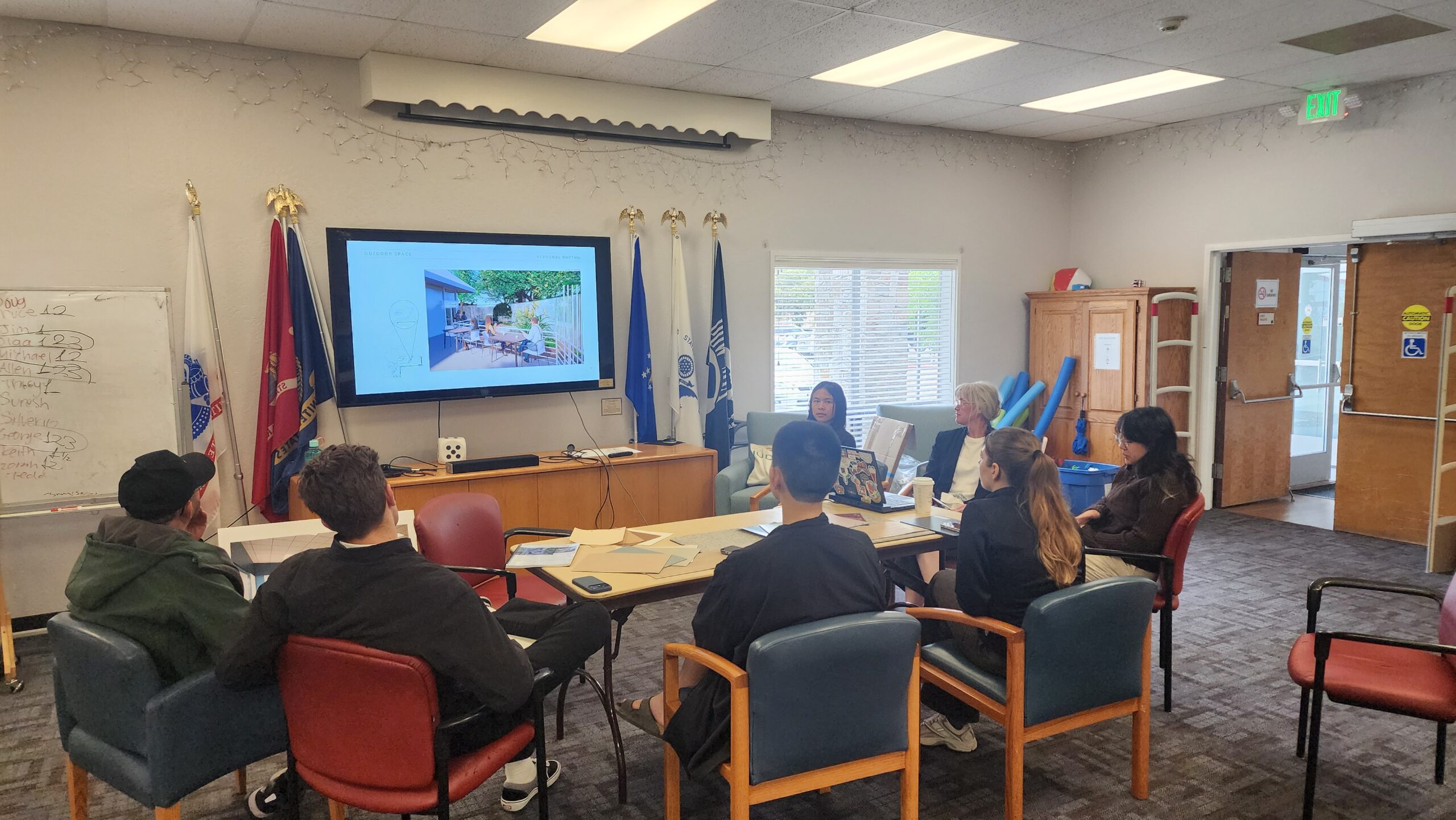
- SASCC Pro Bono Project – Final presentation to clients
- Graduate Work Sample (INTD 70 Advanced Graphic Techniques) – Anne-Marie Hart
- Student Work Sample (INTD 70 Advanced Graphic Techniques) – Sam Krivanek
- Graduate Work Sample (INTD 60 Commercial Design) – Brooke Johnson
- Graduate Work Sample (INTD 60 Commercial Design) – Brooke Johnson
- Graduate Work Sample (INTD 85 Design Detailing) – Anne-Marie Hart